
U.S. Department of State
A Walk Through Diplomatic History
Virtually stroll through downtown Washington with us as we commemorate the 250th birthday of the United States through the lens of U.S. diplomacy.
Each stop tells a story of America's journey — diplomacy building partnerships, solving problems and creating possibilities.
Are you ready?
U.S. Department of State
We begin at the Harry S. Truman Building — the headquarters of the U.S. Department of State since 1947.
The secretary of state works here. Appointed by the president and confirmed by the Senate, he is the president's chief foreign affairs adviser. The secretary carries out the president's foreign policies through the department’s bureaus, offices and programs.
U.S. Department of State
The First Federal Agency
From assisting travelers abroad to negotiating trade deals, diplomacy is about building relationships that protect and promote American interests.
Let's rewind to 1789. Just months after the Constitution took effect, Congress created the Department of Foreign Affairs, the very first federal agency.
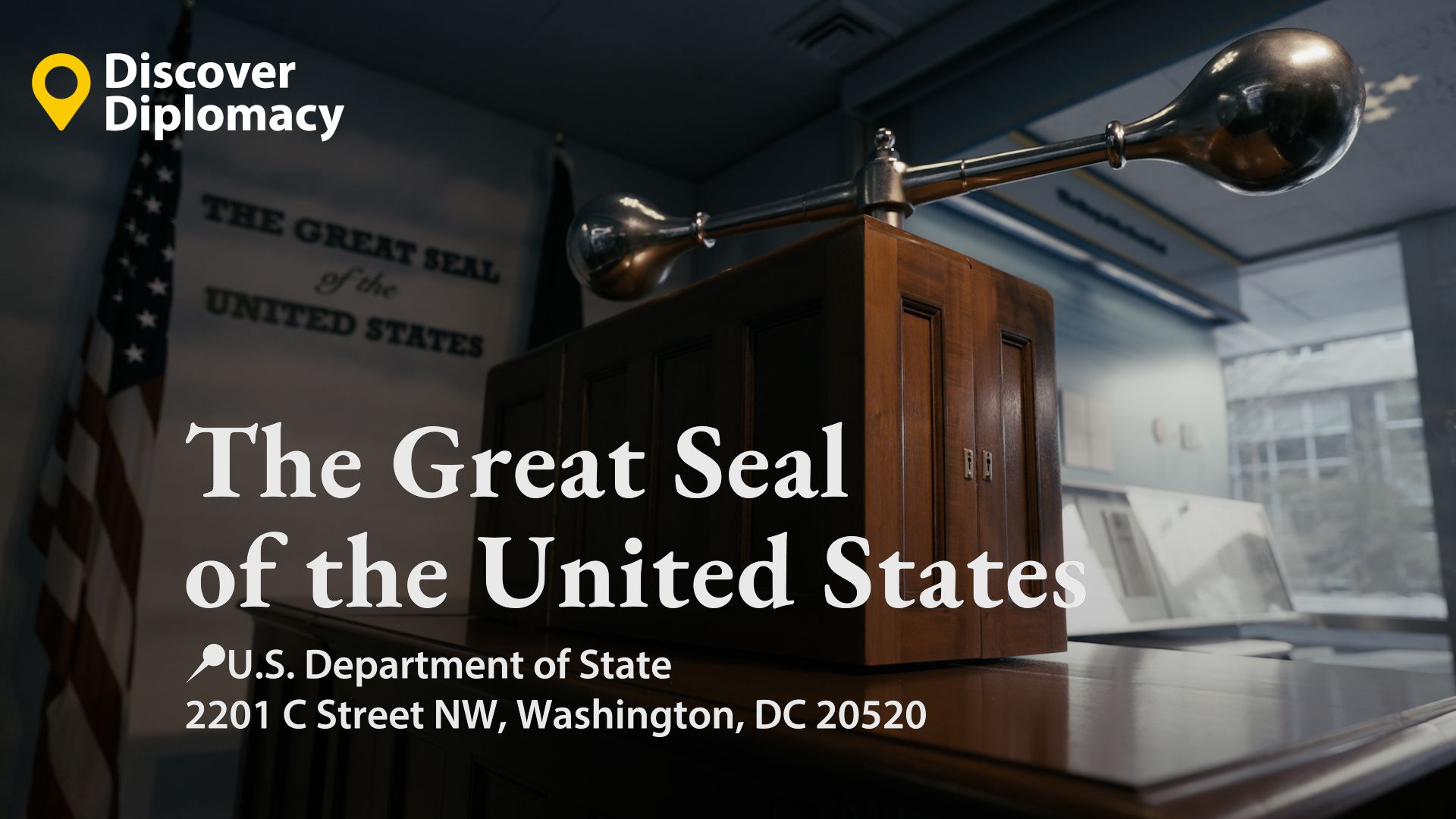
A few months later, its name changed to the Department of State. Why? Because in addition to foreign policy, it also handled things like the census, federal records, and something special — keeping the Great Seal of the United States, the official symbol of our country.
Whenever the United States signs a treaty with a foreign government, that seal is applied.
The Department of State started with just a handful of employees. Today, it manages embassies and consulates in over 190 countries.

The people doing that work come from every corner of the country. They're part of the U.S. Foreign Service and Civil Service — and before they're posted to places like London, Mexico City or Tokyo, many start their jobs right here.
This is where diplomacy begins.
National Museum of American Diplomacy
Welcome to the National Museum of American Diplomacy, inside the Harry S. Truman Building, the Department of State’s headquarters. This is the first museum in the United States dedicated to showing how American diplomats help shape our world. After a major expansion, it reopens in 2026 with new exhibits and hands-on experiences.
National Museum of American Diplomacy
Stories That Shape the World
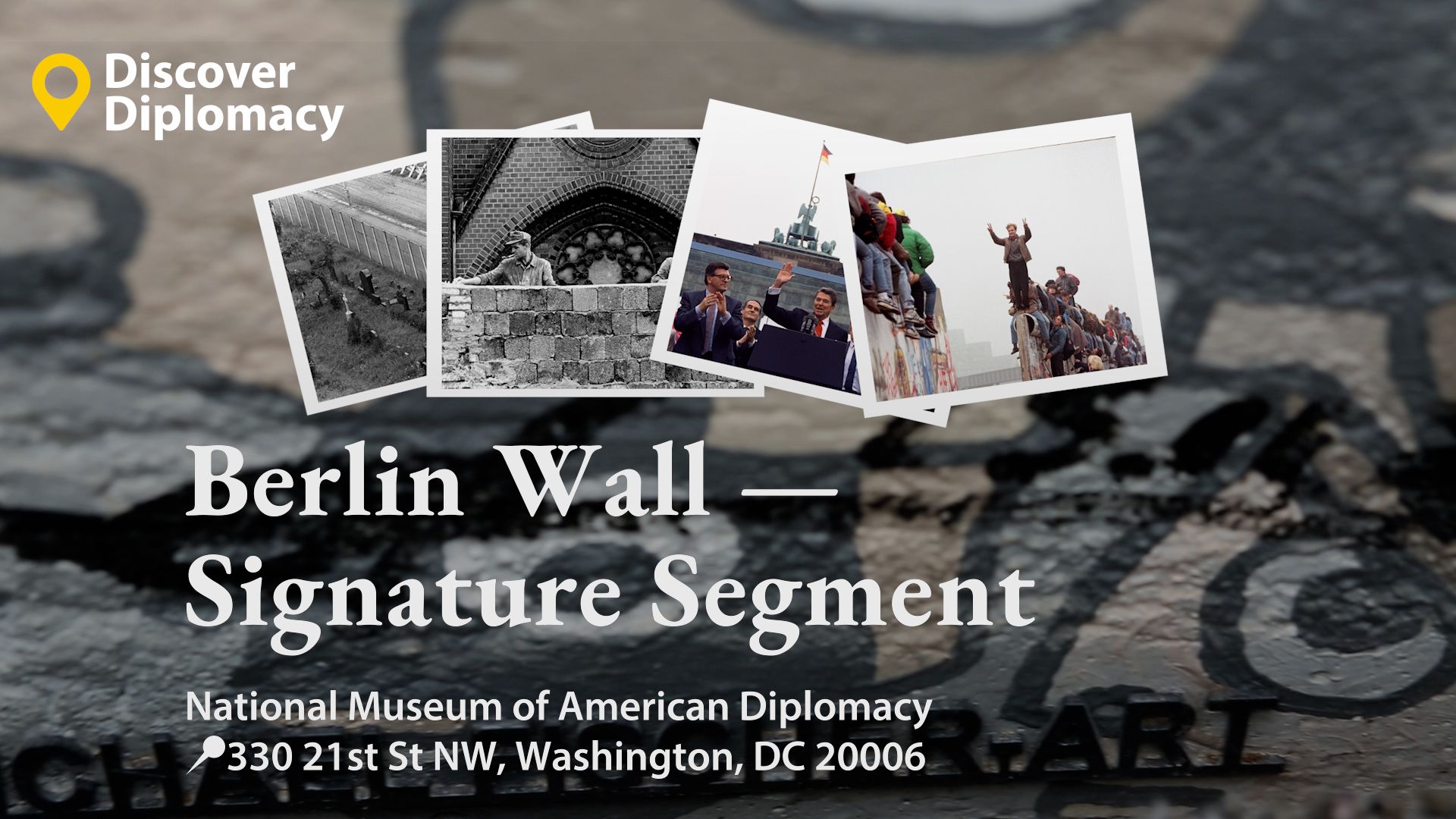
In the year 2000, the vision for this museum took shape. Its more than 10,000 objects bring diplomacy to life through real stories. A section of the Berlin Wall here offers a powerful reminder that diplomacy helped bring the Cold War to an end and reunited a city that had been divided for decades.

Inside, you'll start your visit in the Welcome Hall, which introduces today's global challenges and the people working to solve them. A section called "Diplomacy Is Relationships" explores how each U.S. partnership around the world is unique and why those relationships further America's interests.
José de San Martín
Along Virginia Avenue is a statue of José de San Martín, one of Latin America's great liberators and a man who took pride in learning from the U.S. Declaration of Independence and Constitution.
San Martín helped win independence for Argentina and Chile, and the United States supported his cause for freedom from Spain.
José de San Martín
Recognition, Trade and Friendship
This monument is a gift to the United States from the people of Argentina. It's an exact copy of the monument to San Martín in Buenos Aires — a piece of Argentina's capital, recast for America's capital.
When the statue was dedicated in 1925, President Calvin Coolidge called it "an invitation to understanding, to cooperation." Each year, on May 24, Argentine officials and citizens join U.S. officials to celebrate Argentina's Independence Day and recognize the United States' role in that history.

The United States and Argentina established diplomatic ties in 1823, but the region was still changing, with years of conflict and shifting borders before things fully settled.
In 1853, the United States signed a Treaty of Friendship, Commerce, and Navigation with the Argentine Confederation — an "amity" treaty. These agreements helped turn shared values into real rules for trade, travel and cooperation.
The Octagon House
Don't let the name fool you. The Octagon House only has six sides. Back in the 1800s, "octagon" was a trendy architectural term. It sounded impressive, even if the math didn't quite add up.
Colonel John Tayloe III, one of the wealthiest men in Virginia, built this house as a winter retreat. He hired William Thornton, the same architect who designed the U.S. Capitol. At the time, Washington was the new capital city for our new nation. The Octagon became one of the city's finest homes.
The Octagon House
A Six-Sided Slice of History
Then came the War of 1812, America's second fight with Great Britain. Much of the conflict took place over the seas. Trade was restricted, and British ships stopped American vessels and seized American sailors.
By the summer of 1814, the war reached Washington. On August 24, British troops marched into the capital and set fire to major buildings, including the Capitol and the White House. The occupation was brief — about a day — but tremendous damage took place.
Quick thinking may have saved the Octagon House. As the British arrived, a French tricolor flag flew outside this house, and it wasn't by accident. French diplomat Louis Serrurier was staying here as a guest of Ann Ogle Tayloe, the owner's wife and a well-connected hostess. With a foreign diplomat inside and a French flag outside, the Octagon looked like protected diplomatic ground. That may be one reason it was spared while so much of Washington burned.

With the White House in ruins, President James Madison and first lady Dolley Madison needed a place nearby where the president could keep working. The Tayloe family invited them to stay here at the Octagon. For six months, this house became the temporary White House.
During that time, the Octagon House became the setting for history-making decisions. In February 1815, Madison signed the Treaty of Ghent here, officially ending the War of 1812. The treaty brought peace, restored borders, and reset diplomatic relations between the United States and Great Britain. Today, the Octagon House, proof that diplomacy can solve conflicts and build prosperity, is preserved by the American Institute of Architects.
DACOR Bacon House
Just a short stroll from both the White House and the Department of State sits a lesser-known but important hub of diplomacy: the DACOR Bacon House. It has quietly hosted decades of meaningful conversations over a good meal or in its peaceful garden.
Built in 1825, the house has welcomed foreign royalty, ambassadors, secretaries of state and even presidents.
DACOR Bacon House
Diplomacy Over Dinner
In the 1870s, it even served as the official residence of the Russian Imperial minister in Washington — hosting diplomatic events and welcoming visitors like Grand Duke Alexei, the son of Tsar Alexander II. The same truth holds: Diplomacy runs on relationships.
Its modern diplomatic story begins with Virginia Murray Bacon, the home's last private owner.

Murray Bacon was a skilled hostess and connector. She inherited the house from her husband, Robert Bacon, whose father was once secretary of state. She invited foreign and American diplomats here to meet in a quiet setting, away from cameras, headlines and curious ears. In 1980, Murray Bacon donated the house to the newly formed Bacon House Foundation with a clear vision: to promote peace and understanding by offering a space where foreign leaders could meet with American officials in a relaxed setting. That vision expanded in 1985, when the foundation partnered with DACOR, or Diplomatic and Consular Officers, Retired. Today, the DACOR Bacon Foundation hosts regular events for both retired and active diplomats.
In recent years, DACOR Bacon House hosted a private meeting between the ambassadors of Armenia and Azerbaijan — two countries locked in a long and painful conflict. The details weren't made public. But the point was to get the right people back into the same room and make it possible to talk again, carrying forward Murray Bacon's legacy.
Eisenhower Executive Office Building
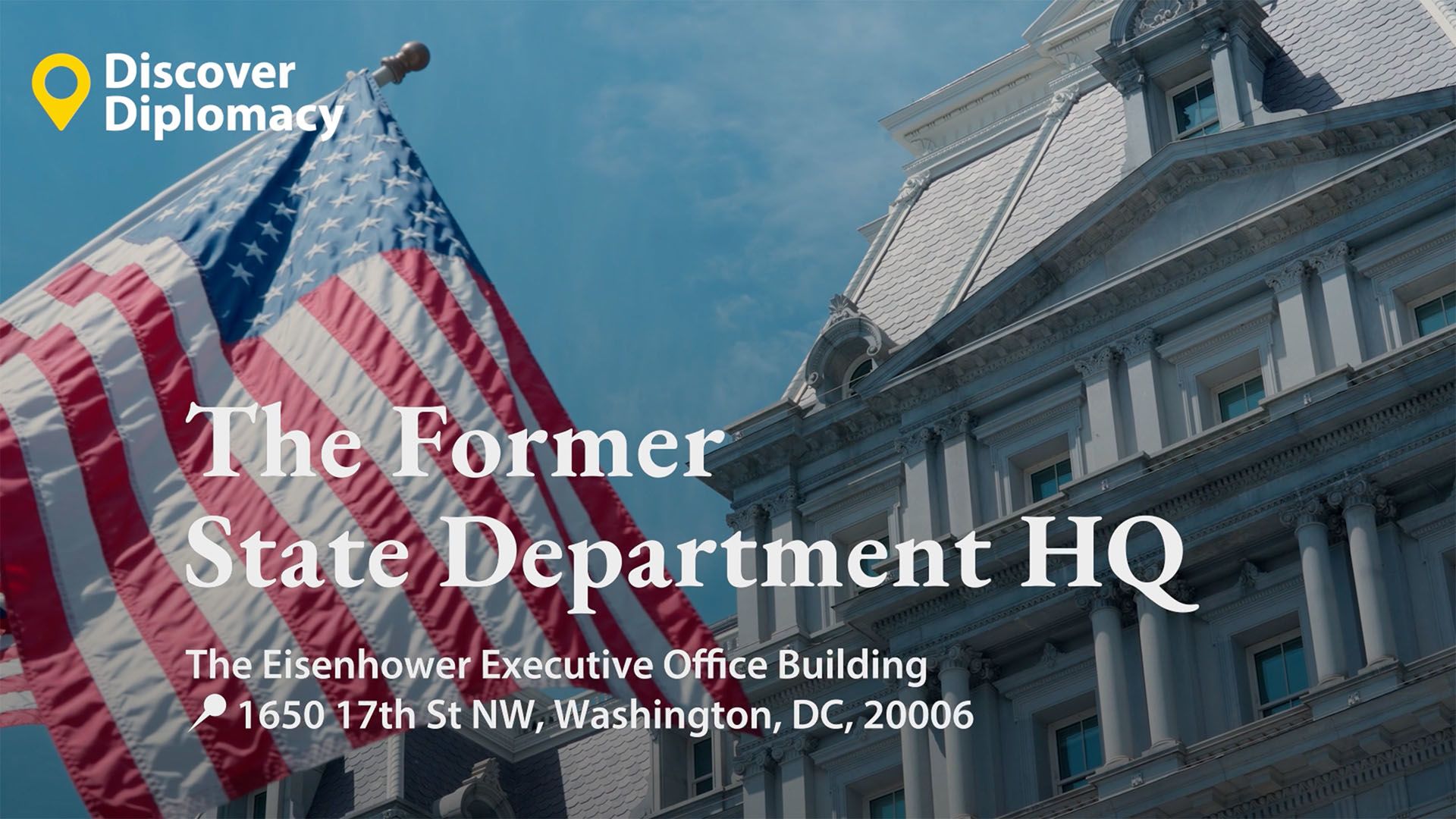
The Eisenhower Executive Office Building, with its bold French-inspired design, rows of chimneys, and ornate ironwork, is distinctive among federal buildings.
It took 17 years to build, from 1871 to 1888. When it was done, it was the biggest office building in the city. Back then, it was called the State, War, and Navy Building, with all three departments housed under one roof.
Eisenhower Executive Office Building
Where U.S. Diplomacy Grows
From 1875 to 1947, this was the headquarters of the Department of State. Diplomats working here helped shape American foreign policy through wars, economic booms and busts, growing trade and America's rise on the world stage. Secretaries of state like John Hay and Cordell Hull worked here.
The building has nearly 2 miles of black-and-white checkerboard hallways, 83 fireplaces, eight grand staircases and skylights overhead.
This building witnessed a moment that transformed American diplomacy: December 7, 1941. Secretary of State Cordell Hull had one last meeting with Japanese Ambassador Nomura. The Japanese had requested a 1 p.m. meeting to deliver a message from Tokyo, supposedly to finalize terms for achieving peace in East Asia. However, they arrived late at 2:05 p.m., after the attack on Pearl Harbor was already underway. Hull kept them waiting another 15 minutes, already knowing that war between the two countries was inevitable and that Japanese promises about peace negotiations were empty. The war that followed would accelerate changes already underway.

Despite its size, this building couldn't keep up with America's expanding global role. The Navy left first in 1918, and the War Department followed in 1938. The Department of State stayed the longest, leaving in 1947 for a new headquarters, now called the Harry S. Truman Building. Today, the Eisenhower Executive Office Building supports the Executive Office of the President. It continues to serve as a place where visiting diplomats meet with White House teams like the National Security Council and sometimes Department of State officials.
Blair House
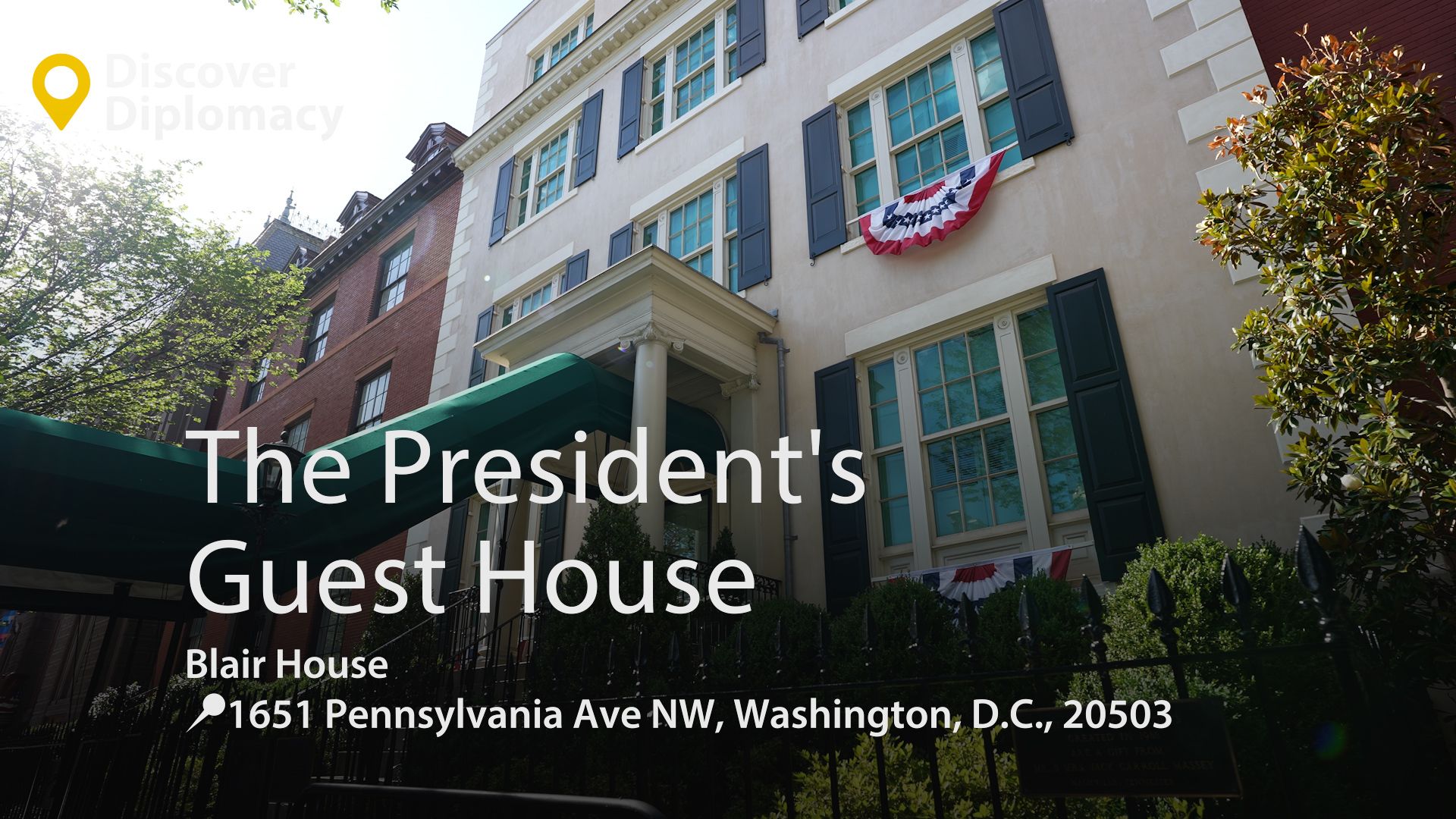
While it might look like a quiet row house, Blair House is one of the most important diplomatic spaces in the nation.
Known as the President's Guest House, this is where the president of the United States invites select world leaders to stay while conducting diplomatic business. An invitation to stay at Blair House is a unique honor and may only be extended by the president.
Blair House
The President’s Guest House
Built in 1824, it was once home to Francis Preston Blair, a newspaper editor and close adviser to President Andrew Jackson. One of the most recognizable rooms in Blair House is the Lee Drawing Room, which features a rare 18th-century Chinese wallpaper that was hand-painted in China before being sold around 1760 to an English patron.
In the 1940s, the U.S. government bought Blair House and turned it into the official guest house for visiting heads of state to use at the president's invitation. Today, the modern Blair House complex spans four houses and occupies 70,000 square feet. The home has welcomed a record number of guests since 2025. Tens of thousands of meals are served every year. This isn't just a place to stay — it's the beating heart of world-class diplomatic hospitality.
The Blair House is overseen by the Office of the Chief of Protocol, which sets the stage for the president's diplomatic meetings at home and abroad. From flowers to flags to the exchange of gifts, nothing is left to chance. Why? Because in diplomacy, even small details carry big meaning about shared history, mutual interests and goals for a partnership.

Blair House has hosted a wealth of historic moments. In 1978, President Jimmy Carter hosted a luncheon for the Camp David Accords interpreters — recognizing the importance of precise spoken words in international diplomacy. Decades later, in April 2012, Blair House was the setting for a Middle East Quartet meeting.
Even the furnishings at Blair House are full of history. In 2020, a special table from Blair House was taken over to the White House for President Trump to sign the Abraham Accords, the agreement that normalized relations between Israel and several Arab countries, starting with the United Arab Emirates and Bahrain.
This was President Harry S. Truman's actual Cabinet table, where he sat with his team in the late 1940s making some of America's biggest foreign policy decisions — the Marshall Plan, the Truman Doctrine, the U.S. decision to enter the Korean War. Fast forward more than seven decades and that same table is back — this time witnessing peace in the Middle East.
Diplomacy isn't just about the public-facing, televised moments. As first lady Melania Trump observed in remarks at Blair House, it's about "offering warmth, security and hospitality to ... leaders from every corner of the globe."
Lafayette Square
Lafayette Square is a small park across from the White House that honors the power of international alliances and shared ideals.
The big horse-and-rider statue in the center is Andrew Jackson. The statues around Jackson’s likeness represent some of America's early friends.
Lafayette Square
A Park of Global Friendship
The Marquis de Lafayette, a young French nobleman who crossed the ocean at age 19 to fight for liberty, is represented in the southeast corner. His bravery helped persuade France to support the American Revolution, creating an alliance that became a turning point in the war. The southwest corner features a statue of Comte de Rochambeau, who brought French support at a critical time.
Nearby is a statue of Baron von Steuben from Prussia, the drillmaster who helped shape the Continental Army into a disciplined force. And in another section of the park is the likeness of Tadeusz Kościuszko of Poland, an engineer who supported the reinforcement of American defenses.
Why are these four statues here? Each played a role in supporting American independence and spreading beyond America’s borders the democratic ideals inspired by the Revolution. This park shows that, from the very beginning, diplomacy was part of the American DNA.

Lafayette Square is also a stage for public diplomacy. It’s a place where the United States connects with everyday people. On Christmas Eve 1938, President Franklin D. Roosevelt lit the community Christmas tree here and, with war threatening overseas, reminded the nation, "We desire peace. We shall work for peace."
It's a great reminder that diplomacy isn't only done behind closed doors. Sometimes, diplomacy happens out in the open, with hope and tradition bringing people together.
The White House
The White House, at 1600 Pennsylvania Avenue, is home to the president of the United States and one of the most iconic buildings in the world.
When foreign leaders visit, they don't just slip in a side door. They arrive to a formal welcome: an honor guard of service members holding flags, national anthems and a red carpet at the front entrance. The president steps out from the West Wing to greet them at the door, and the leaders walk inside together. It's a clear message: This relationship matters.
The White House
American Leadership in Action
Inside, the business of diplomacy takes place in many forms. The president and his aides host state dinners, sign treaties and hold press conferences that make headlines around the world.
Every detail of a diplomatic engagement — from the way flags are displayed to how a meal is served — is carefully planned to show respect and promote the United States as a global leader. And just steps away, in the Oval Office, presidents have managed crises, made deals and welcomed new ambassadors since President William Howard Taft began using the first Oval Office in 1909.
First ladies have played key roles too. From Jacqueline Kennedy to Nancy Reagan to Melania Trump, they've used soft power — art, education and culture — to build bridges with foreign visitors and showcase the best of American talent.

The White House is a center of global engagement, where diplomacy lives and breathes every day.
Ashburton House
Welcome to Ashburton House, an early 19th-century stately residence just off Lafayette Square. Today it's part of St. John's Episcopal Church, but in 1842, this house played a starring role in easing tensions between Great Britain and the United States over our northern neighbor — Canada, then a British colony.
At that time, there was a conflict over a confusing and contested border between Maine and what is now the New Brunswick and Quebec provinces. Both sides claimed the same forested region, rich in timber but with no clearly marked boundary. The standoff grew so heated it sparked what became known as the Aroostook War. No blood was shed, but militias mobilized. It was the closest the United States and Britain came to war after 1812.
Ashburton House
From Standoff to Signatures
To resolve the crisis, Great Britain sent Lord Ashburton to Washington. Secretary of State Daniel Webster offered this home as Ashburton's place to stay and a quiet place to talk. For 10 months, the two men worked tirelessly and joined banquets, offered toasts and held late-night talks. Webster and Ashburton shared more than maps; they shared meals, brandy and friendship.

The result? The Webster-Ashburton Treaty of 1842 settled the U.S.-Canada boundary from Maine to the Great Lakes. It averted war, and it set up joint patrols to stop the illegal slave trade.
Afterward, the house briefly served as the British Legation, an early version of an embassy. Today, Ashburton House is used for church meetings and events.
The Willard Hotel
The lobby of the historic Willard Hotel (now called Willard InterContinental) has been a backdrop to some of America's most important diplomatic moments. Influential visitors check in, and Washington watches them come and go.
The Willard
Washington’s Unofficial Embassy
In 1860, the streets outside were buzzing. Members of Congress left their desks to see the first official Japanese delegation to visit the United States.
Inside, the Willard Hotel became a kind of temporary embassy. Interpreters hovered over documents. Staff carried trunks and gifts up to suites. And curious onlookers lingered in hallways hoping for a glimpse of the action.

For the United States, the visit was a sign that a usually reserved nation was willing to talk. For Japan, this hotel offered a close-up look at a loud, fast-growing republic — with its politics, its technology and its everyday habits, right down to the unfamiliar food served.
The Willard is also famous for another kind of diplomacy: citizens working to persuade their leaders to address their interests. Washington legend says President Ulysses S. Grant liked to sit in the lobby to smoke cigars while people crowded around to push their causes — "lobbyists," as the story goes.
Benjamin Franklin Statue
Benjamin Franklin in statue looks thoughtful and slightly amused, as if he's just come up with another brilliant idea.
You might know him as the guy who flew a kite in a thunderstorm or printed almanacs full of witty quotes. But he was also one of America's first diplomats.
Benjamin Franklin Statue
America’s First Diplomat
In 1776 — when America was a new idea and the rebellious colonies desperately needed allies in their war for independence — Franklin sailed to France on a mission that changed history. Franklin's job? Convince the French to support the American cause.
At 70 years old, he became an unlikely celebrity in Paris, wearing a plain brown coat and fur cap to play up his image as the wise, but humble, American. He charmed everyone from royals to radicals, and he earned their trust.

In 1778, France agreed to a military alliance. French troops and ships soon joined the war. Later, Franklin helped negotiate the Treaty of Paris, officially ending the war and gaining recognition of U.S. independence.
Franklin's legacy lives on in every American embassy, every peaceful negotiation and every moment when conversations matter.
Old Post Office Tower
The Old Post Office Tower houses the Bells of Congress, a gift from Britain to the United States in 1976, celebrating America's bicentennial. They're full-sized replicas of the bells at Westminster Abbey in London and were cast by the same London foundry that made the Liberty Bell, which hangs in Independence Hall in Philadelphia.
Old Post Office Tower
Bells That Bridge Nations
Why did Britain send bells? Because symbols matter in diplomacy. These bells honor a long-lasting friendship, one that started in rebellion but grew into one of the world's strongest alliances.

Each bell is inscribed with a message. The largest one reads just three words: Wisdom. Courage. Love.
Inside this building is a mix of old and new — historical architecture, modern businesses and the tower's observation deck, which offers one of the best views of Washington. But the bells remind us that gestures matter. Diplomacy can be about more than treaties and speeches. It can also be a gift freely given, to say, “We value this relationship.”
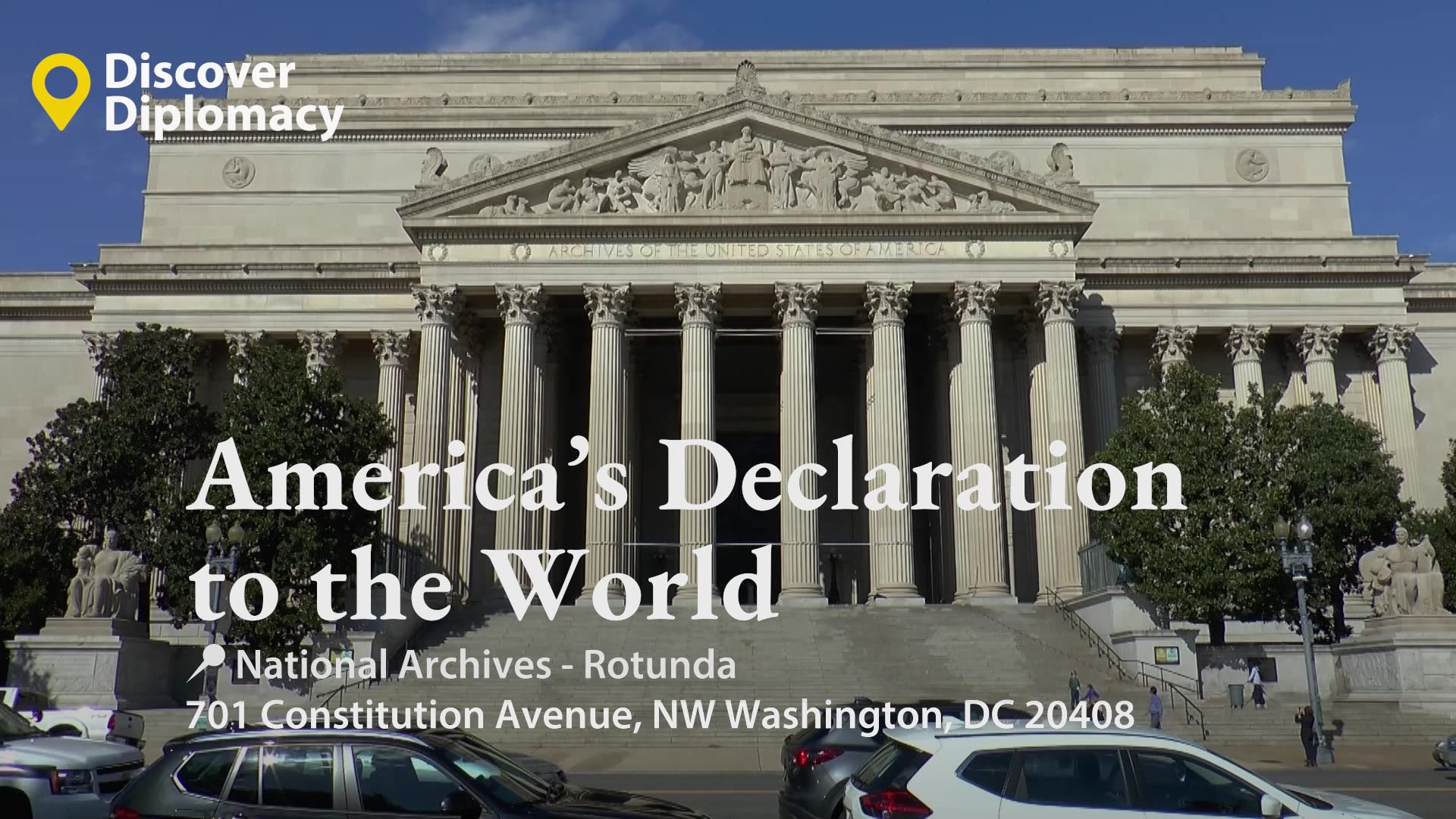
National Archives
The National Archives houses the founding documents of the United States: the Declaration of Independence, the Constitution and the Bill of Rights. They're exhibited in a softly lit rotunda that was built especially for this purpose. These documents may be old, but their message still rings loud and clear.
These documents did more than build a country; they launched its foreign policy.
National Archives
Diplomacy Starts with Documents
The Declaration of Independence wasn't just a message to King George III. It was a signal to the world that the United States was ready to become its own nation and fulfill its own destiny. Expressing the importance of "life, liberty, and the pursuit of happiness," the Declaration helped persuade France to become an ally in our fight for independence.
The Constitution laid the foundation for American diplomacy. It made the president the commander in chief, in charge of protecting the country, and it also made the president our top diplomat. In Article II, the Constitution gives the president the power to make treaties and appoint ambassadors to represent the United States overseas.
The Bill of Rights expressed essential American values — freedom of speech, religious liberty, due process and much more. Intended to endure across generations, these principles have helped shape America's national character from the founding to the present day.

The National Archives building holds a treasure trove of diplomatic history: treaties, diplomatic cables, photographs, audio and video, and even artifacts that showcase our diplomatic history. One standout is the Foreign Relations of the United States series. Started in 1861, it's an official record showing how diplomatic decisions were made. It’s publicly available and one of the most transparent projects of its kind in the world.
By preserving this history, the National Archives helps us remember that diplomacy is built on more than handshakes. It's built on values and on the idea that, even in disagreement, dialogue and core principles matter.
The Smithsonian Castle
The Smithsonian Institution is home to space rockets, ruby slippers, historic treaties and artwork that captures American life over the past 250 years. With 21 museums and the National Zoo, the Smithsonian Institution is packed with some of America's most-loved treasures. It's a place for learning, discovery … and even diplomacy.
The Smithsonian Castle
Curiosity Meets Diplomacy
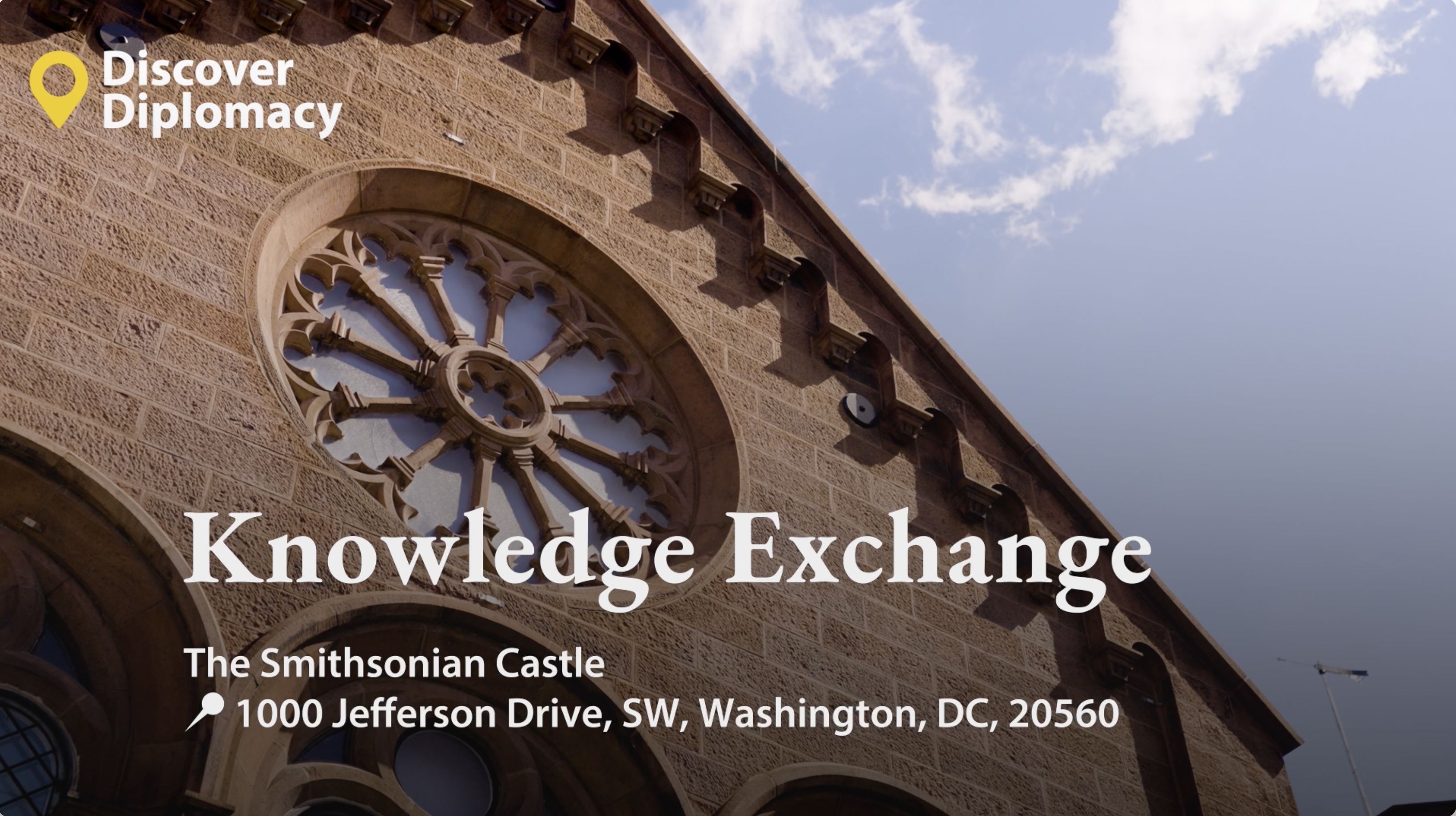
It all started with a surprise gift. In 1826, British scientist James Smithson left his fortune to the United States, a country he'd never set foot in. His goal was to build an institution "for the increase and diffusion of knowledge" — in other words, to discover more and share it widely.
Smithson had a complicated start. He was the duke of Northumberland's illegitimate son, and the duke never claimed him as family. So, Smithson made his own name through science, becoming a respected chemist and mineralogist. And he seemed to like America's big idea that knowledge should be for everyone.
The Smithsonian Institution’s first building is a red sandstone “Castle.” Completed in 1855 with stone from Maryland's Seneca Creek, it still represents a love for curiosity, learning and cultural exchange.

Today, the Smithsonian Institution connects not just Americans, but the world. It works with more than 140 countries, sharing exhibits, training museum staff, conducting research and helping preserve heritage. And it supports what's sometimes called public diplomacy — building goodwill through culture, education and shared experiences.
One way it brings diplomacy to life is by teaming up with the Department of State on programs like American Spaces. American Spaces are friendly cultural centers — often in libraries or schools — where people can learn about the United States, practice English or join events that bring our stories to life.
That's the spirit of public diplomacy, and the Castle is where many of those bridges begin.
From statues to treaties, bell towers to drawing rooms, you've seen how diplomacy has protected us, connected us, represented us and helped our country grow and thrive in its first 250 years.
This story was drafted by the U.S. Department of State’s Office of the Historian.